
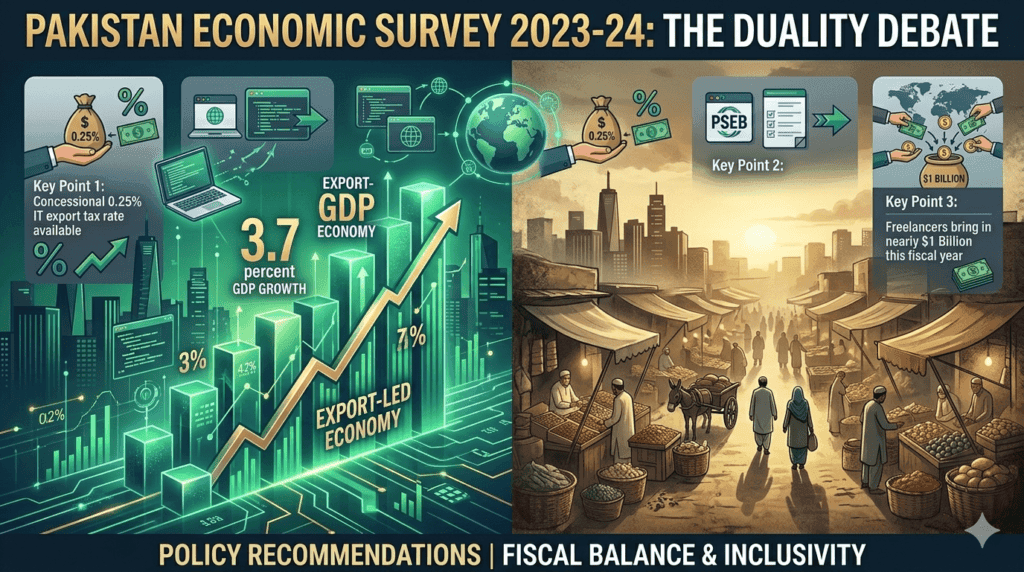
The latest Pakistan Economic Survey 2025-26 has unveiled a mixed economic landscape, reporting the nation’s nominal Gross Domestic Product (GDP) at a historic high of Rs126.9 trillion, equivalent to $452.1 billion, alongside a concerning rise in poverty to 28.9%. This comprehensive review highlights a year of remarkable resilience and strategic fiscal consolidation amidst significant global and domestic challenges.
What Happened
Pakistan’s economy demonstrated considerable vigour in FY26, achieving a GDP growth rate of 3.7%, marking a four-year high. This trajectory represents a significant rebound from a negative 0.2% in FY23, through 2.6% in FY24, and 3.2% in FY25. Per capita income also saw an uptick, rising to $1,901 from $1,751 in the preceding year. Finance Minister Aurangzeb characterised the survey as a testament to the nation’s resilience and disciplined economic management.
The fiscal year was shaped by three major exogenous factors: initial tariff uncertainty from global trade negotiations, severe monsoon floods in August-September 2025, and a regional conflict breaking out in March 2026. Despite these headwinds, the government successfully pursued fiscal consolidation, narrowing the fiscal deficit to a commendable 0.7% of GDP from 2.6% a year prior. Federal Board of Revenue (FBR) revenues surged by 10.1% annually, with a notable 46% year-on-year jump in June 2026, contributing to a doubling of the tax base over two years.
On the external front, Pakistan recorded a current account surplus of $72 million during July-March FY26, largely bolstered by robust remittance inflows, which hit a record $4.25 billion in May 2026. Export performance was mixed; while food sector exports declined by $1.5 billion (primarily rice and sugar), textile exports showed growth in woven garments, home textiles, and knitted garments. Crucially, IT exports reached $3.8 billion in the first ten months, projected to hit $4.5 billion by year-end, with freelancer earnings expected to cross $1 billion. Inflation in Pakistan also witnessed a sharp decline from previous crisis levels, indicating improved macroeconomic stability.
Analysis
The FY26 Pakistan Economic Survey 2025-26 underscores a critical period of economic stabilisation, where disciplined fiscal management and strategic policy interventions played a pivotal role in navigating a complex global and domestic environment. The significant reduction in the fiscal deficit and the achievement of a current account surplus are robust indicators of improved macroeconomic health, crucial for attracting foreign investment and ensuring sustainable growth. This fiscal prudence, coupled with declining markup payments, created essential fiscal space for development initiatives.
The resilience of the agricultural sector, growing at 2.89% despite devastating floods, highlights the effectiveness of timely government interventions and the National Agriculture and Food Security Council. The recovery of major crops like sugarcane and wheat is vital, given agriculture’s substantial contribution to national GDP and employment. Similarly, the broad-based growth in Large-Scale Manufacturing (LSM) at 6.1%, and services at 4.9%, signals a diversified economic recovery, moving beyond reliance on a few sectors. The surge in IT exports and Roshan Digital Account inflows reflects a growing digital economy and enhanced confidence among overseas Pakistanis, offering a promising avenue for future foreign exchange earnings.
However, the persistent challenge of rising poverty to 28.9% despite economic expansion points to the uneven distribution of growth benefits and the urgent need for inclusive policies. While the overall economic indicators suggest a path towards stability, the impact of external shocks like global trade uncertainties and regional conflicts continues to necessitate vigilant policymaking. The successful 5G spectrum auction and increased digital skills training are positive steps towards enhancing productivity and competitiveness in the digital age, crucial for long-term economic transformation.
Key Takeaways
- Pakistan’s GDP growth reached a four-year high of 3.7% in FY26, with nominal GDP at a record Rs126.9 trillion, signalling economic recovery.
- Fiscal consolidation was successful, narrowing the fiscal deficit to 0.7% of GDP and achieving a current account surplus of $72 million.
- Key sectors like agriculture (2.89%), Large-Scale Manufacturing (6.1%), and services (4.9%) demonstrated strong, broad-based growth.
- Poverty remains a significant concern, climbing to 28.9%, indicating challenges in inclusive growth and equitable distribution of economic benefits.
- Robust remittance inflows ($4.25 billion in May 26) and growing IT exports ($3.8 billion in 10 months) are crucial foreign exchange earners.
The Insider Take
For Pakistani investors and businesses, the Pakistan Economic Survey 2025-26 offers a cautiously optimistic outlook. The achieved fiscal consolidation and current account surplus are critical for enhancing investor confidence, suggesting a more stable macroeconomic environment. This stability, coupled with declining inflation, should translate into a more predictable operating landscape for businesses. Sectors showing strong growth, particularly IT exports and certain segments of manufacturing like automobiles and electrical equipment, present compelling investment opportunities. The government’s focus on agriculture, despite climate challenges, also underscores its potential for value-added growth.
However, the persistent rise in poverty is a stark reminder that economic growth alone is insufficient without equitable distribution. Businesses should consider strategies that contribute to broader societal uplift, potentially through job creation in high-growth sectors or investing in regional development. The sustained inflow of remittances and the growth of the digital economy via RDA and IT exports are structural positives that can cushion external shocks. Local businesses should look to leverage the expanding digital infrastructure and trained workforce to enhance efficiency and explore new markets, particularly in the e-commerce and tech-enabled services space.
PS: For educational purposes only. Not financial advice. Investing involves risk.