
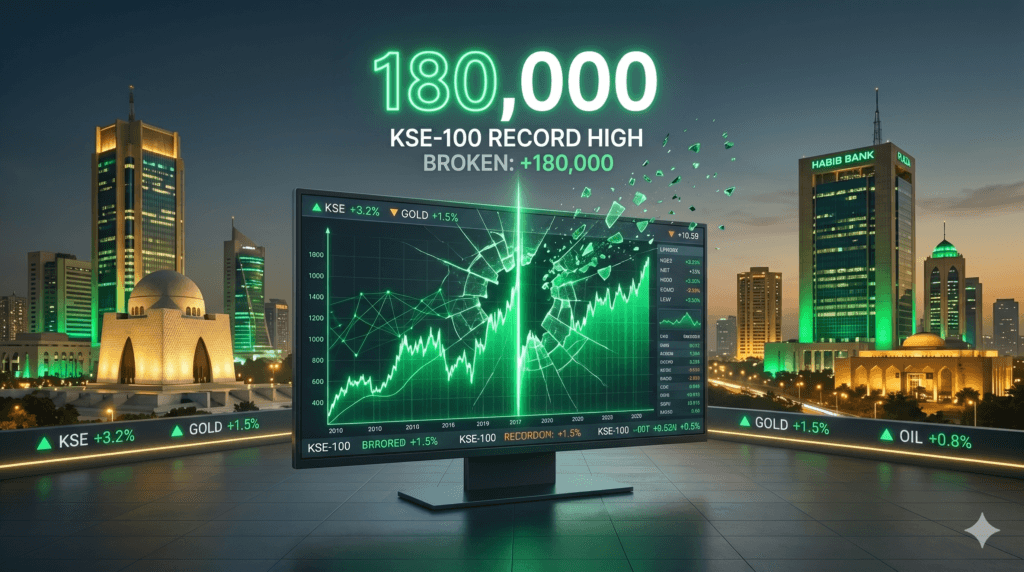
History was made on the Pakistan Stock Exchange this week. On Tuesday, June 16, the KSE-100 index crossed 180,000 points in intraday trading for the first time ever — capping a two-day rally that added roughly 7,750 points, or 4.5%, to the benchmark index. For context: this same market touched its all-time low panic point of 151,973 just over three months ago, on March 2, when a single session wiped out 16,089 points — the largest one-day fall in the exchange’s history.
The distance between those two moments, fear and euphoria, was just fifteen weeks. This article breaks down exactly what happened, why, and what the four most realistic paths forward look like for PSX investors.
Monday: The Twin Catalyst Day
Monday’s session set the tone. The KSE-100 index broke decisively through the psychologically important 175,000 level via what Arif Habib Limited described as a “strong gap-up,” closing 4,639.92 points higher — a 2.69% gain — at 177,039.83. Of the 100 index constituents, 87 stocks rose and only 13 fell, a near-unanimous show of buying conviction rarely seen even in strong markets.
Two distinct catalysts converged on the same morning. First, a preliminary peace agreement between the United States and Iran was confirmed, with Pakistani Prime Minister Shehbaz Sharif announcing on social media that “a deal had been struck,” while reports indicated the agreement included reopening the Strait of Hormuz — the critical waterway through which a significant share of global oil shipments pass. Oil prices fell sharply on the news, easing the inflationary pressure that had forced Pakistan to absorb a fuel import bill of roughly $800 million per week during the conflict.
Second, momentum from the federal budget for fiscal year 2026-27 — presented by Finance Minister Muhammad Aurangzeb just days earlier — continued to filter through the market. The budget included lower taxes on sectors such as cement and textiles, targeted 4% GDP growth, and set an 8.2% inflation goal, all while staying broadly aligned with IMF programme commitments.
Perhaps the most telling development of the day came from the State Bank of Pakistan, which held its policy rate unchanged at 11.5% — becoming, according to market commentary, the first central bank globally to formally respond to the Iran peace deal by betting that falling oil prices would do the disinflationary work that further rate hikes might otherwise have been needed for. That is a subtle but important signal: the central bank is now positioning for rate cuts, not further hikes, in the second half of 2026.
Related Coverage: Read our detailed report on KSE-100 falls 1,500+ points amid geopolitical tensions and Pre-Budget Panic.
Related Coverage: Read our detailed report on US and China Reach “Preliminary Consensus” on Trade Deal, Averting New Tariffs.
Tuesday: Crossing 180,000
If Monday was the breakout, Tuesday was confirmation. The market opened firmly and by 9:34am had already added 1,267.86 points, building steadily through the morning. By 1:14pm, the KSE-100 index stood at 180,149.76 points — up 3,109.94 points, or 1.76% — having touched an intraday high of 180,499.96. The session’s low of 177,741.46 remained comfortably above Monday’s close, a sign that buyers, not sellers, were in control of every dip.
Trading activity was robust: more than 408 million shares changed hands, with total traded value reaching PKR 38.91 billion — meaningfully higher than Monday’s already-strong PKR 26.78 billion. Buying broadened across automobile assemblers, chemicals, commercial banks, oil and gas exploration companies, oil marketing companies, and refineries, suggesting the rally had moved beyond a narrow set of large-cap names into genuine market-wide participation.
Every major sectoral index closed in the green. The Banking Index gained 3.58%, the highest among major sub-indices, directly reflecting growing expectations that the SBP’s next move will be a rate cut rather than a hike. The Islamic finance benchmark, KMI-30, added 1.31%. Dividend-focused stocks, captured in the PSXDIV20 index, rose 2.66%.
Why This Matters Beyond the Headline Number
Pakistan’s equity market has spent much of 2026 trading as a direct proxy for Middle East geopolitical risk. When tensions escalated — as they did dramatically on March 2 and again on May 18 — KSE-100 index fell sharply because of the country’s heavy dependence on imported oil. When tensions eased — as on April 8 and again this week — PSX rallied for the identical reason in reverse. This is not unique to Pakistan, but few markets in the world have shown this degree of sensitivity to a single external variable.
What makes this week’s rally more durable than the April 8 spike, which subsequently reversed as conflict rhetoric resumed, is that it arrived alongside a domestic catalyst — the budget — and a central bank signal — the rate hold with implied future cuts — that are independent of the geopolitical situation. Even if Middle East tensions resurface, Pakistan’s fiscal and monetary trajectory has shown enough independent improvement that a full reversal to March’s panic lows appears considerably less likely than it did three months ago.
Four Scenarios From Here
No single forecast captures the range of plausible outcomes. Here are the four most coherent paths, each with its triggers and implications.
Scenario one: peace confirmed, rates cut, new all-time high. If the formal US-Iran agreement is signed without complications later this week, and oil prices settle meaningfully lower — toward the $75–85 per barrel range — Pakistan’s inflation trajectory could fall fast enough to permit a SBP rate cut of 100 to 150 basis points within the next two policy meetings. Under this path, the January 2026 all-time high of 191,033 would likely be reclaimed within six to ten weeks, with broker targets extending toward 200,000–215,000 thereafter. Banks, cement, and consumer-facing sectors would lead.
Scenario two: consolidation in a 175,000–183,000 range. This is arguably the most statistically likely near-term outcome. After a 15,000-point, two-week advance, some sideways digestion is normal and healthy market behaviour rather than a warning sign. Under this scenario, the index trades in a defined range for several weeks while the market awaits confirmation of the peace deal’s durability and early data on whether inflation is actually falling as hoped.
Scenario three: a profit-taking pullback to 168,000–175,000. Given that a meaningful share of the rally’s participants bought in the depths of the May sell-off, a degree of profit-taking is a near-certainty at some point. The most likely trigger would be friction in the details of the peace agreement — reports have already noted that Iran intends to regulate Strait of Hormuz traffic jointly with Oman, raising questions about shipping tolls and execution. A 5 to 8% retracement from current levels would not represent a change in trend; it would represent a healthy, buyable dip.
Scenario four: the peace deal unravels. The lowest-probability but highest-impact scenario involves the formal signing failing or hostilities resuming. Oil would likely spike back toward $110–120 per barrel almost immediately, and the KSE-100 index could retreat 10 to 15% toward the 160,000–165,000 zone that proved to be reliable support in May. Even in this scenario, the structural improvements in Pakistan’s reserves, remittances, and fiscal trajectory suggest any such pullback would likely find buyers rather than trigger a deeper structural decline.
Weighing these scenarios, the combined probability of the index trading meaningfully higher than today’s level within six months appears considerably greater than the probability of a sustained reversal — though geopolitical outcomes by their nature resist precise quantification.
What Investors Should Watch
Three markers deserve close attention in the days ahead. The formal signing ceremony for the US-Iran agreement, reportedly scheduled for later this week, is the most immediate test of whether this rally has structural staying power or represents another optimistic overshoot. The trajectory of oil prices over the following two to three weeks will determine how quickly — and how convincingly — Pakistan’s inflation data improves. And the State Bank’s next monetary policy decision will reveal whether Tuesday’s implicit signal of future rate cuts translates into action.
For long-term investors, the more important takeaway may be a simpler one: markets compress years of sentiment swings into weeks. The same KSE-100 index that fell 9.57% in a single panicked session in March has now gained over 18% from that low. Neither the panic nor the euphoria fully reflected Pakistan’s underlying economic reality at the time it occurred. The discipline of staying invested in fundamentally sound businesses through both extremes — rather than reacting to either — remains the most reliable approach available to ordinary investors navigating an extraordinary year.
PS: For educational purposes only. Not financial advice. Investing involves risk.