
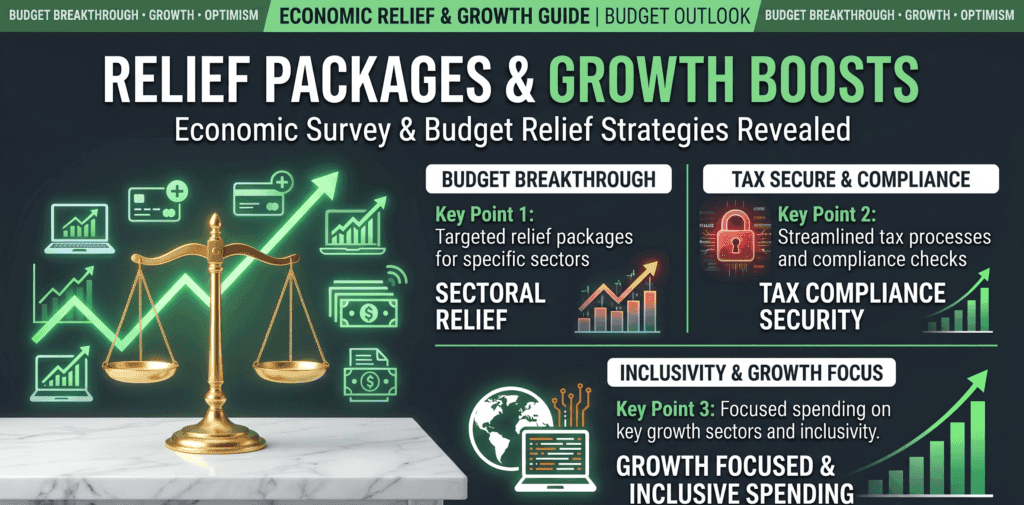
Federal Minister for Finance and Revenue, Muhammad Aurangzeb, has unveiled the Pakistan Budget FY2026-27 in the National Assembly. Backed by the IMF’s stabilization mandate, this 18.8 trillion rupee budget represents a critical pivot.
While the state is focused on locking in a 2% primary surplus, the actual measures announced today offer some of the most significant tax cuts and operational reliefs for freelancers, digital builders, and middle-class professionals in a decade.
Here is the straightforward breakdown of the winners, the losers, and how you must position your assets to build and protect your wealth.
Key Macro Targets:
- Total Budget Outlay: Rs. 18.771 trillion (up 6.8% YoY).
- Tax Revenue Target: Rs. 15.264 trillion (a 17.6% YoY high).
- Primary Budget Surplus: Locked at 2.0% of GDP, with a net deficit of 3.6% of GDP.
- Inflation & GDP Targets: Average inflation is projected to cool to 8.2%, with a real GDP growth target of 4.0%.
- Debt Servicing: Set at Rs. 8.054 trillion, which consumes the largest portion of the budget.
The Winners: Freelancers, Exporters, and Middle-Class Earners
This budget represents a massive win for the digital economy and the salaried class. The government has clearly recognized that to grow the economy, it must stop choking its most productive citizens.
1. IT Export Tax Relief
The single most critical takeaway for our community is the extension of the IT export tax relief. The highly concessional 0.25% final tax regime (FTR) on IT export proceeds, which was set to expire on June 30, 2026, has been officially extended for three years until June 2029. This provides incredible policy certainty for remote developers, agency owners, and independent freelancers bringing hard USD into the country.
2. The 90% Card Tax Cut: Internet Shoppers Rejoice
If you use international debit, credit, or prepaid cards to pay for foreign cloud hosting, software subscriptions, or online ads, your costs just plummeted. The advance withholding tax on foreign card transactions has been cut by 90%, dropping from 5% to just 0.5%. This is designed to discourage informal money transfers and pull digital transactions back into formal banking channels.
3. Salaried Class Tax Slabs
In a surprise directive from the Prime Minister, the tax burden on middle-income salaried professionals has been reduced. The updated salaried class tax slabs show rate cuts across key brackets:
- Rs. 22 to 32 lac bracket: Reduced from 23% to 20%.
- Rs. 32 to 41 lac bracket: Reduced from 30% to 25%.
- Rs. 41 to 56 lac bracket: Reduced from 35% to 29%.
- Rs. 56 to 70 lac bracket: Reduced from 35% to 32%.
Furthermore, the 9% incremental surcharge previously levied on salaried individuals earning over Rs. 10 million per year has been completely abolished. Minimum wage has also been increased by 10% to Rs. 44,000, and federal salaries are up by 7%.
4. Corporate Super Tax Relief
To stimulate local business reinvestment, the super tax relief Pakistan framework has been activated. The super tax for small-to-medium corporations with profit-after-tax (PAT) below Rs. 500 million is completely abolished. For companies earning over Rs. 500 million, the super tax has been trimmed from 10% to 8% (excluding the banking, energy, and fertilizer sectors).
Direct exporters also get a boost: total tax collection on export proceeds has been cut from 2% to 1.25%, and the 0.25% Export Development Surcharge has been abolished, while the markup rate for the Export Refinance Scheme has been slashed to 4.5%.
The Losers: Luxury Imports, Non-Filers, and Heavy Commuters
While middle-class earners and digital exporters celebrate, the budget squeezes luxury consumption and non-filers aggressively.
Imported Cars and Electric Vehicles: Federal Excise Duty (FED) is being introduced on imported luxury vehicles between 2000cc and 3000cc. More importantly, a new FED will be imposed on imported high-end electric vehicles (EVs) valued above Rs. 20 million (Rs. 2 crore). However, concessions for local EV bikes, rickshaws, and buses remain intact.
The Non-Filer Squeeze: The exclusion from enhanced tax rates for non-filers on capital gains from listed securities has been completely withdrawn. If you are trading on the PSX as a non-filer, you will be hit with punitive tax rates, leaving you with no choice but to register with the FBR.
Digital Platforms Withholding: A brand new withholding tax has been introduced on revenues received through digital platforms (including YouTube, Facebook, Instagram, and TikTok). Creators and influencers earning from ad revenue will now be taxed at source.
The Insider Take:
Double Down on Your Digital USD Pipeline: With the 0.25% IT export tax rate secured for the next three years and the card transaction tax slashed to 0.5%, the digital export economy is the most tax-advantaged sector in Pakistan. If you are still working a local, PKR-salaried job, this is your signal to transition your skills globally immediately.
Clean Up Your PSX Portfolio: The abolition of the super tax for companies earning under Rs. 500 million and the reduction to 8% for larger firms is a massive structural tailwind for listed mid-cap and small-cap companies. Focus your PSX investments on corporate groups with low debt and high local earnings that directly benefit from this tax relief.
Become an Active Filer Today: The budget has made life virtually unlivable for non-filers in the stock market and real estate. With property purchase withholding taxes rationalized to flat rates of 1.5% and 2.75% for filers, documented capital is being rewarded while undocumented wealth is being heavily penalized.
PS: For educational purposes only. Not financial advice. Investing involves risk.