
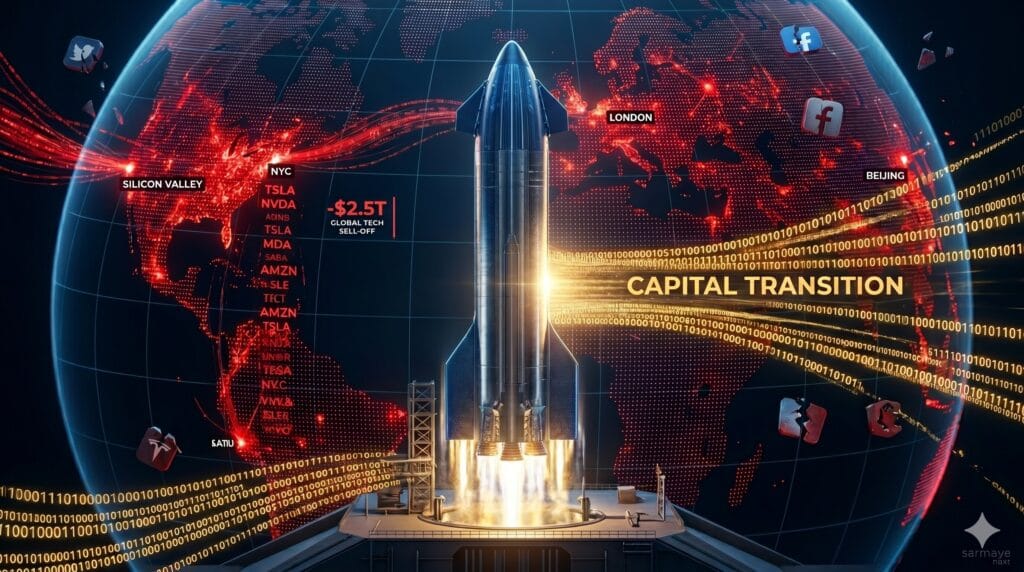
A massive $2.5 trillion has evaporated from global equity and cryptocurrency markets in a single session, marking the most brutal sell-off of 2026. For young Pakistani investors and digital earners, this rapid global market correction 2026 is a stark warning that the macroeconomic landscape is shifting and that learning how to protect investments from market crash is now an urgent priority. This dramatic repricing reflects a confluence of factors, from unprecedented pre-IPO capital siphoning to a hawkish Federal Reserve, all conspiring to reset investor expectations globally.
Key Takeaways:
- The $2.5 Trillion Wipeout: A lethal combination of macroeconomic shocks and pre-IPO positioning triggered a massive global exit from active tech and crypto assets.
- The SpaceX Siphon: Investors are aggressively liquidating existing tech holdings to build cash reserves for the historic $1.75 trillion SpaceX IPO launching on June 12, alongside upcoming listings for OpenAI and Anthropic.
- Broadcom’s AI Reality Check: Despite posting strong earnings, Broadcom’s decision to keep its long-term AI guidance unchanged sparked fears that hyperscaler infrastructure spending is hitting a near-term ceiling.
- The Fed Rate Shock: An incredibly strong US jobs report shattered hopes of interest rate cuts, driving the 10-year US Treasury yield to 4.48% and raising fears of potential rate hikes.
Friday’s market crash was not a random panic; it was a highly logical liquidity reshuffle, driven by a series of interconnected events. The primary catalyst is the upcoming SpaceX IPO (ticker: SPCX) on June 12, which is targeting an unprecedented $75 billion to $80 billion raise at a staggering $1.75 trillion valuation. To participate in what is being hailed as the biggest stock market launch in human history, institutional and retail funds globally are actively dumping active S&P 500 and Nasdaq holdings. This creates a massive liquidity vacuum as millions search for how to buy SpaceX shares, pulling capital away from existing investments and into cash reserves.
The Pre-IPO Siphon Effect
The “SpaceX Siphon” is a critical phenomenon. Funds that would typically flow into the broader market are being redirected. This effect is compounded by anticipated mega-IPOs from other tech giants like OpenAI and Anthropic, further straining market liquidity. For Pakistani investors, this means that even seemingly robust global tech stocks can experience sudden downward pressure, irrespective of their individual fundamentals, purely due to this capital reallocation. This pre-IPO positioning has created a perfect storm, forcing a broad market reset.
This pre-IPO cash grab collided with a major AI wake-up call that many fear is the start of a broader AI stock market crash. Broadcom, a bellwether for custom AI chips and a key supplier to hyperscalers, beat earnings expectations but failed to raise its fiscal 2027 AI sales guidance. This sent its stock tumbling 13.7%, dragging tech giants like Nvidia, AMD, and other AI-related stocks down with it. Investors are now realizing that the astronomical valuations in the AI sector are finally facing a reality check, suggesting that the initial explosive growth phase of AI infrastructure spending might be moderating or shifting focus.
AI Hype Meets Reality
The market’s reaction to Broadcom’s guidance signals a potential shift into what Gartner’s Hype Cycle calls the “Trough of Disillusionment” for AI. After an initial “Peak of Inflated Expectations,” investors are scrutinizing actual return on investment and sustainable growth, rather than just potential. This reassessment is crucial for Pakistani tech entrepreneurs and investors who have been riding the global AI wave, as it indicates a more mature, and potentially more challenging, landscape ahead.
Adding fuel to the fire was an incredibly strong US jobs report, which shattered hopes of impending interest rate cuts by the Federal Reserve. The report indicated a robust US economy, suggesting that inflationary pressures might persist, giving the Fed little incentive to ease monetary policy. This drove the benchmark 10-year US Treasury yield to 4.48%, making riskier assets like equities less attractive in comparison. More concerning for global markets, the data raised fears of potential *further* rate hikes, directly impacting borrowing costs for companies and governments worldwide. For Pakistan, higher US interest rates typically lead to a stronger US Dollar, increased cost of borrowing for dollar-denominated debt, and potential capital flight from emerging markets, putting immense pressure on the Rupee and the nation’s external accounts.
The Insider Take: What This Means for Your Sarmaya
This $2.5 trillion correction changes the global investment outlook. Here is how you can protect your capital and navigate this high-volatility phase:
- Do Not Chase the Crypto “Dip” Immediately: The tech stock sell-off spilled directly into the crypto market, dragging Bitcoin and Ether down as investors fled to cash. Because the SpaceX IPO launch on June 12 will keep global tech liquidity highly constrained for the next week, expect crypto volatility to continue. The capital being pulled for these mega-IPOs is substantial, and its impact will be felt across all risk assets. Wait for the post-IPO liquidity to settle and clearer market signals to emerge before deploying your cash and targeting the next crypto crash recovery. Patience here is key to avoiding further losses.
- Reposition for the “Trough of Disillusionment”: Broadcom’s stagnant long-term AI outlook suggests the initial hype phase of AI infrastructure is cooling. If you are a tech freelancer or developer in Pakistan, stop selling basic AI-implementation services. The market is maturing. Pivot to “efficiency optimization” and “ROI tracking” services—these are the exact metrics enterprises are now demanding as they try to justify their massive AI investments. Focus on helping businesses demonstrate tangible returns from their AI deployments, rather than just building new AI tools. This shift in focus can open new, more resilient revenue streams.
- Hedge Against Dollar Strength: The blowout US jobs report means US interest rates will remain higher for longer, which historically strengthens the US Dollar against developing currencies like the Pakistani Rupee. This directly impacts the purchasing power of your local currency earnings and savings. Ensure your savings are securely hedged in stable, dollar-denominated assets, such as US dollar accounts, foreign currency bonds, or even certain export-oriented Pakistani equities that benefit from a stronger dollar. This strategy helps protect your purchasing power from domestic inflation and the chronic depreciation of the Rupee, providing a crucial safeguard in an unpredictable global economic climate.
PS: For educational purposes only. Not financial advice. Investing involves risk.