
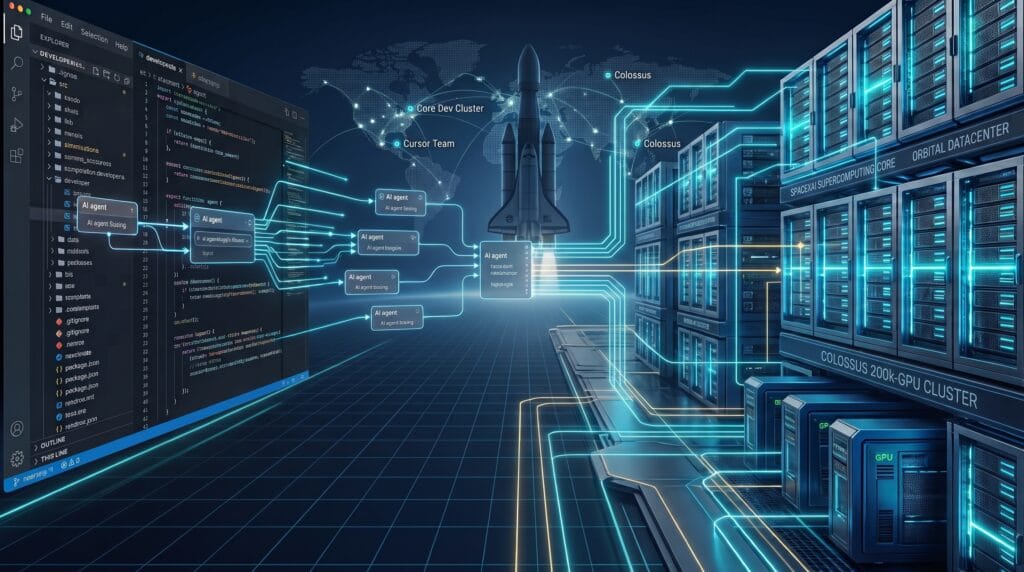
In a significant move that reshapes the artificial intelligence landscape, Elon Musk’s SpaceX has officially closed its SpaceX Cursor acquisition, integrating the AI coding startup into its rapidly expanding technology portfolio. The deal, valued at a substantial $60 billion, underscores SpaceX’s aggressive push into AI, combining advanced programming tools with unparalleled computing infrastructure.
What Happened
The acquisition of AI coding startup Cursor by SpaceX was formally completed on August 15, 2026, marking the culmination of a process that began just four months prior. The journey started in April 2026 when SpaceX and Cursor announced a technology partnership, which notably included an option for SpaceX to acquire Cursor for $60 billion. This option solidified into a firm commitment two months later, in June 2026, following SpaceX’s transition to a public company.
Cursor, renowned for its AI-powered programming tools and code editor, will now operate as an integral part of SpaceX. A primary driver for Cursor in this merger is the promise of direct access to SpaceX’s formidable computing infrastructure. Cursor’s own announcements repeatedly highlighted that by joining SpaceX, it would gain access to what it describes as “the largest fleet of GPUs in the world,” including the powerful Colossus supercomputer, which is equipped with 200,000 Nvidia GPUs. This massive computational capacity has previously been rented out by SpaceX to other major clients, including Anthropic and Google.
The collaboration between the two entities was already well underway before the official closure. Sources indicate that Cursor had been a close partner in training SpaceX’s Grok AI models, specifically contributing to Grok 4.5 and Grok 4.6 using “trillions of tokens of Cursor data.” This partnership also extended to bundled software subscriptions, with Cursor Ultra and Cursor Premium Teams subscribers gaining access to SpaceX’s new AI agent, Grok Bot. Despite the rapid progression of the deal, Elon Musk maintained a cautious stance on discussing specifics during SpaceX’s August earnings call, citing regulatory considerations associated with the acquisition closing post-IPO. Furthermore, SpaceX currently faces a lawsuit concerning pollution linked to its data center gas turbines, adding an environmental dimension to its expanding computing operations.
Analysis
The SpaceX Cursor acquisition signals a profound strategic move by Elon Musk to consolidate critical components of the AI value chain under the SpaceX umbrella. Following its earlier acquisition of xAI, this deal positions SpaceX not only as a developer of advanced AI models but also as a powerhouse in the underlying computing infrastructure that fuels them. The immediate and most tangible benefit for Cursor is the direct pipeline to SpaceX’s immense GPU fleet, a resource that would typically be out of reach for a startup. This access is crucial for scaling AI models beyond current capabilities, addressing the significant ‘compute bottleneck’ that often limits ambitious AI development.
This transaction also highlights a broader AI consolidation trend within the technology sector. As artificial intelligence becomes increasingly sophisticated, access to vast computing resources — specifically high-performance GPUs — is emerging as a critical competitive advantage, akin to owning prime real estate in the digital economy. Companies like SpaceX, with their substantial capital and infrastructure, are uniquely positioned to acquire specialized AI talent and tools, potentially accelerating innovation within their ecosystems while raising questions about the concentration of AI power. The fact that SpaceX also rents out its infrastructure to other AI giants like Anthropic and Google further illustrates its pivotal role, making it both a competitor and a crucial enabler in the AI race.
The timing of the acquisition, occurring roughly two months after SpaceX became a public company in June 2026, added a layer of complexity and scrutiny. This transition to public status necessitated careful navigation of disclosure obligations and regulatory approvals, as hinted by Elon Musk’s circumspect comments. For investors, this move underscores SpaceX’s long-term vision to diversify beyond space exploration, firmly establishing itself as a key player in the burgeoning AI market. However, the ongoing lawsuit regarding pollution from its data center gas turbines introduces an environmental risk factor, which could influence public perception and regulatory oversight as the company continues to expand its AI computing infrastructure. For more on SpaceX’s market entry, read about the SpaceX Stock Debut Soars, Valuing Company at $2.3 Trillion.
Key Takeaways
- SpaceX officially closed its $60 billion acquisition of AI coding startup Cursor on August 15, 2026.
- The deal grants Cursor immediate access to SpaceX’s vast computing infrastructure, including the Colossus supercomputer and what it calls the “largest fleet of GPUs in the world.”
- This acquisition strengthens SpaceX’s AI strategy, integrating AI development tools with its powerful computing resources, which it also provides to major AI clients like Anthropic and Google.
- The transaction occurred after SpaceX became a public company in June 2026, requiring careful regulatory navigation.
- An ongoing lawsuit concerning pollution from SpaceX’s data center gas turbines highlights potential environmental considerations associated with large-scale AI infrastructure expansion.
The Insider Take
For Pakistani businesses and investors, the SpaceX Cursor acquisition serves as a potent reminder of the escalating importance of computational power in the global AI arena. As the world increasingly pivots towards AI-driven solutions, access to high-performance computing infrastructure, particularly advanced GPUs, is becoming a non-negotiable prerequisite for innovation and competitive edge. This consolidation trend, where companies like SpaceX leverage their immense capital and hardware to acquire specialized AI talent and tools, illustrates that the future of AI is not solely about algorithms or data, but fundamentally about the sheer computational muscle to train and deploy these complex models at scale.
For Pakistan, which aims to become a significant player in IT exports and technology innovation, this development carries a crucial lesson. While directly replicating SpaceX’s colossal GPU fleet might be aspirational, the strategic imperative is clear: fostering local investment in advanced computing facilities, forging partnerships for cloud-based AI infrastructure access, and critically, developing a workforce skilled in leveraging such powerful tools will be vital. The ability to efficiently utilize and manage robust AI computing infrastructure will determine the pace and scale of AI adoption and development within the country, allowing Pakistani startups and enterprises to remain competitive in a rapidly evolving global technological landscape.
PS: For educational purposes only. Not financial advice. Investing involves risk.