
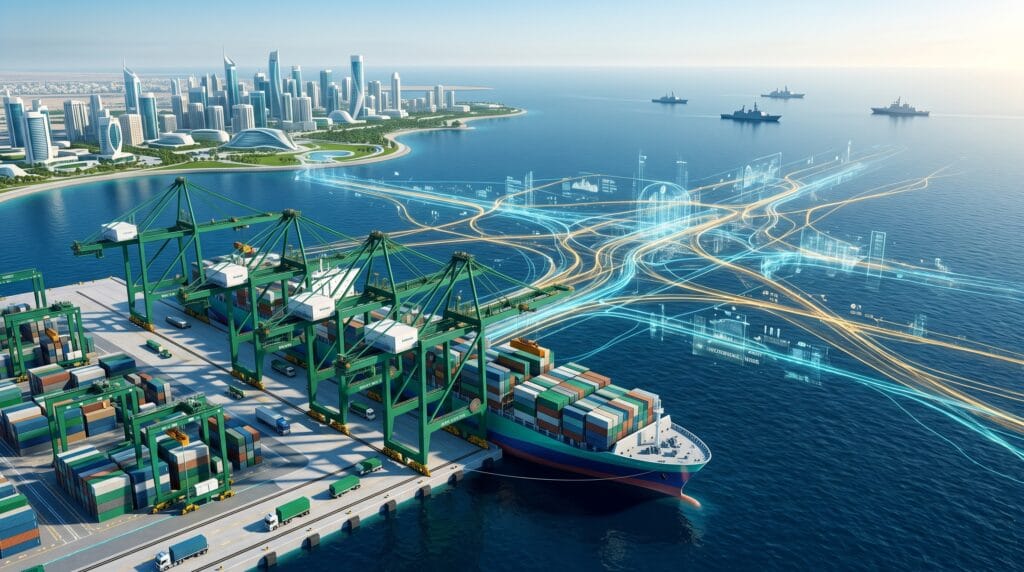
Pakistan stands on the cusp of a significant economic transformation, with its vast maritime resources identified as a largely untapped “blue economy” holding the potential to generate over USD 100 billion annually. This ambitious vision, championed by the Federation of Pakistan Chamber of Commerce and Industry (FPCCI), highlights the strategic importance of the nation’s coastline and Exclusive Economic Zone.
What Happened
Saquib Fayyaz Mangoon, Senior Vice President of the FPCCI, recently underscored this immense opportunity during a flag-hoisting ceremony marking Pakistan’s 79th Independence Day at Federation House Karachi. Attended by prominent figures including Vice Admiral Faisal Amin, Commander Coast, and Brigadier Yaqoob Awan, along with numerous business leaders, the event served as a platform to advocate for greater focus on Pakistan’s maritime sector. Mangoon stated that while the maritime economy currently contributes approximately 0.4 percent to Pakistan’s GDP, concerted planning and investment could unlock its true value.
He detailed that Pakistan’s nearly 1,000-kilometre coastline, coupled with its extensive Exclusive Economic Zone (EEZ) and strategically located ports, offers substantial potential for economic development. The FPCCI Senior Vice President emphasized that the blue economy extends far beyond traditional fishing. It encompasses a diverse array of sectors, including shipping, ports and logistics, fisheries and aquaculture, shipbuilding and ship repair, maritime tourism, offshore energy, and marine technology. To realize this potential, Mangoon called for enhanced cooperation between the Pakistan Navy and the business community, proposing public-private partnerships and joint ventures involving FPCCI, the Pakistan Navy, the Ministry of Maritime Affairs, universities, and the private sector.
Analysis
The FPCCI’s emphasis on Pakistan’s blue economy comes at a critical juncture, with global maritime dynamics highlighting the strategic and economic vulnerabilities inherent in sea trade. Recent events, such as the near standstill of transit through the Strait of Hormuz following multiple ship attacks, underscore the fragility of crucial global shipping lanes. This disruption, which saw daily vessel crossings plummet from over 130 before a conflict in February to as low as five on some days, illustrates how geopolitical tensions can severely impact international trade and energy supplies. While the US pledged to maintain a naval blockade on Iran and inflict “measures like have never been seen” for economic isolation, the ripple effects on global oil prices, with Brent futures at about $87 a barrel and WTI crude at $81 a barrel, demonstrate the direct economic consequences of maritime instability.
For Pakistan, developing a robust maritime economic strategy is not just about revenue generation but also about enhancing national resilience and strategic positioning. The nation’s extensive coastline and ports could offer more secure trade routes or become pivotal logistical hubs in a volatile region. By diversifying its blue economy beyond fishing to include advanced shipping, offshore energy, and marine technology, Pakistan can mitigate risks associated with over-reliance on traditional economic sectors and capitalize on its geographical advantage. The call for public-private partnerships and collaboration between the Pakistan Navy and the business community is crucial, as it would leverage both security expertise and commercial acumen to develop this complex sector. This integrated approach is essential to navigate the intricate interplay of economic opportunity and geopolitical realities in the maritime domain.
Key Takeaways
- Pakistan’s blue economy is identified as a significant untapped opportunity, capable of generating over USD 100 billion annually.
- The maritime sector currently contributes only about 0.4 percent to Pakistan’s GDP, indicating substantial room for growth through strategic investment.
- The blue economy encompasses diverse sectors beyond traditional fishing, including shipping, ports, logistics, aquaculture, shipbuilding, maritime tourism, offshore energy, and marine technology.
- Realizing this potential requires stronger cooperation between the Pakistan Navy and the business community, alongside public-private partnerships involving key stakeholders like FPCCI, the Ministry of Maritime Affairs, and universities.
The Insider Take
For Pakistani investors and businesses, the FPCCI’s vision for the blue economy presents a compelling long-term outlook amidst global uncertainties. While the immediate focus might be on traditional sectors, the strategic importance of Pakistan’s maritime assets is amplified by international events, such as the disruptions in the Strait of Hormuz. These global pressures on shipping and energy routes highlight the inherent value of secure, well-developed coastal infrastructure and diversified maritime services. Investing in areas like modern port logistics, sustainable aquaculture, or even nascent offshore energy exploration could yield significant returns as Pakistan seeks to establish itself as a regional maritime hub. Businesses should actively engage with proposed public-private partnership models, seeking to leverage government support and naval expertise to de-risk investments in this capital-intensive yet strategically vital sector. This isn’t merely about economic growth; it’s about positioning Pakistan for greater self-reliance and influence in a world increasingly shaped by maritime power.
PS: For educational purposes only. Not financial advice. Investing involves risk.