
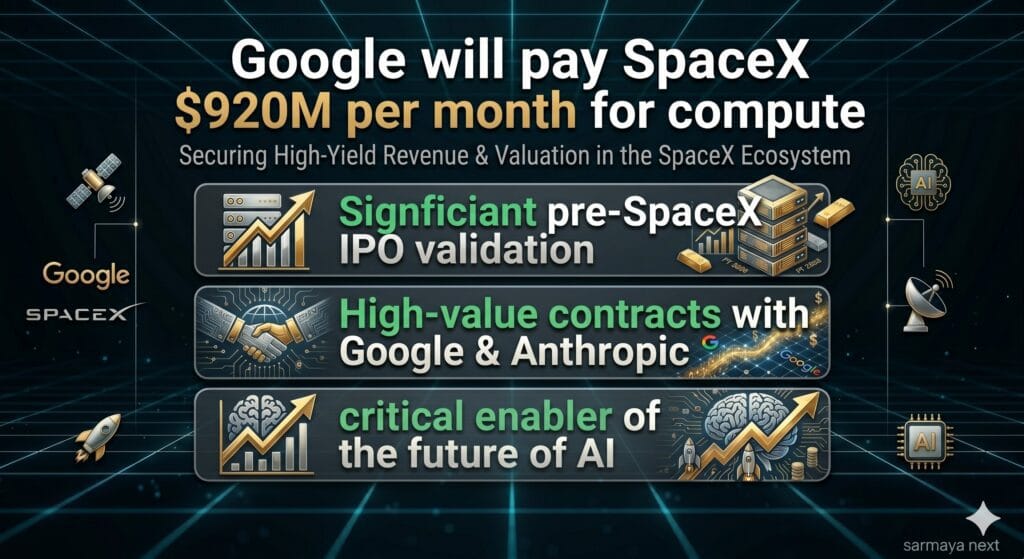
In a significant development underscoring the escalating demand for artificial intelligence infrastructure, Google has finalised a substantial Google SpaceX AI compute deal. This agreement, valued at $920 million per month, highlights the intense competition for high-end computing resources essential for advanced AI operations, positioning SpaceX as a critical enabler in the burgeoning AI market. This strategic alliance not only reshapes the landscape of cloud computing but also signals a new era where access to powerful AI infrastructure becomes a key determinant of technological leadership and innovation.
What Happened
SpaceX, a company on the cusp of a historic SpaceX IPO, recently announced a major compute deal with Google, as disclosed in a regulatory filing. Under the terms, Google will commit $920 million monthly from October 2026 through June 2029. This substantial payment secures access to approximately 110,000 NVIDIA GPUs, along with essential CPUs, memory, and other related components. Given the timeline and the scale, these are expected to be NVIDIA’s most advanced GPUs, such as the H100s or even the upcoming Blackwell B200 series, crucial for training and deploying large language models (LLMs) and complex AI agents.
This agreement mirrors a similar deal SpaceX struck with AI firm Anthropic in May, where Anthropic agreed to pay $1.25 billion per month for compute resources from SpaceX’s Colossus 1 AI infrastructure data centre. While Google’s deal appears to be for roughly half the compute capacity compared to Anthropic’s, it signifies a crucial strategic move for the tech giant. Google stated the deal is a ‘short-term, timely agreement’ to address surging customer demand for its AI products, particularly its agent platform, Gemini Enterprise, which has exceeded internal expectations. The rapid adoption of Gemini Enterprise by businesses for tasks ranging from automated customer service to complex data analysis has created an unprecedented need for immediate, high-performance computing power.
The agreement includes a mutual cancellation clause, allowing either party to terminate with 90 days’ notice after December 31, 2026. This clause provides flexibility for both Google, should its internal compute capacity catch up or market demands shift, and for SpaceX, in case of unforeseen operational challenges or more lucrative opportunities. Google’s access to the data centre will gradually increase through September 2026 at a reduced fee, allowing for a phased integration. This arrangement also includes provisions for Google to terminate or receive reduced fees if SpaceX fails to deliver the committed amount of GPUs by the specified deadline, mitigating Google’s risk in a rapidly evolving technological landscape.
Related Coverage: Read our detailed report on Focused Energy Secures $240M Series A for Fusion Power.
Analysis
This Google SpaceX AI compute deal underscores the unprecedented AI demand surge driving tech giants to secure vast data centre capacity. Despite Google’s estimated position as the world’s largest owner of AI compute, the necessity of this deal highlights the exponential growth in processing requirements for advanced AI models. It signals that even industry leaders are struggling to keep pace with the computational demands of their rapidly evolving artificial intelligence market offerings, particularly in the realm of generative AI and enterprise-level applications.
The AI Compute Arms Race
The global race for AI dominance has transformed into an arms race for compute power. Companies are investing billions in GPUs, data centres, and specialized AI chips. This deal exemplifies the extreme measures being taken to secure this critical infrastructure. The sheer scale of the investment—nearly a billion dollars a month—reflects not just the cost of these cutting-end components but also the premium associated with immediate, guaranteed access to them in a supply-constrained environment. This trend is likely to continue, pushing up capital expenditures across the tech sector.
Google’s Strategic Imperative
For Google, this partnership provides critical ‘bridge capacity’ to meet immediate market needs, preventing potential bottlenecks that could impede the rollout and performance of its new AI products. It also indicates a strategic shift in Google’s cloud computing strategy, as it looks beyond its own extensive infrastructure to external providers like SpaceX to maintain its competitive edge in the fiercely contested AI landscape. Parent company Alphabet’s aggressive capital expenditure, already committed to over $180 billion this year with expectations for significant increases in 2027, further illustrates the scale of investment required to dominate the AI frontier. This spending is not just on servers but also on power infrastructure, cooling systems, and the land to host these massive data centres.
SpaceX’s Evolving Business Model
From SpaceX’s perspective, these compute deals are a significant pre-SpaceX IPO validation. Securing long-term, high-value contracts with industry titans like Google and Anthropic diversifies its revenue streams beyond space launches and Starlink, significantly boosting its valuation ahead of its anticipated $1.75 trillion IPO. It positions SpaceX not just as a space exploration company, but as a critical enabler of the future of AI through its burgeoning data centre operations, showcasing a new dimension of its tech partnerships strategy. This diversification makes SpaceX a more resilient and attractive investment, reducing its reliance on potentially volatile space launch markets.
Pakistani Market Implications
While this deal is global in scale, its implications ripple down to emerging markets like Pakistan. The global AI demand surge means that access to high-end compute resources will become increasingly challenging and expensive for Pakistani startups and researchers. Local companies often rely on global cloud providers like Google Cloud, AWS, or Azure, which themselves are facing capacity constraints. This could lead to higher costs for AI development and deployment in Pakistan, potentially hindering local innovation.
However, it also presents opportunities. The need for robust data centre infrastructure globally could spur local investment in data centres within Pakistan, albeit on a smaller scale initially. Furthermore, the rising demand for AI talent globally highlights the importance of fostering a skilled workforce in Pakistan, capable of developing and managing AI systems. Pakistani tech firms and educational institutions need to focus on AI research, development, and specialized training to tap into this growing global ecosystem, potentially attracting foreign investment or partnerships in the future.
PS: For educational purposes only. Not financial advice. Investing involves risk.