
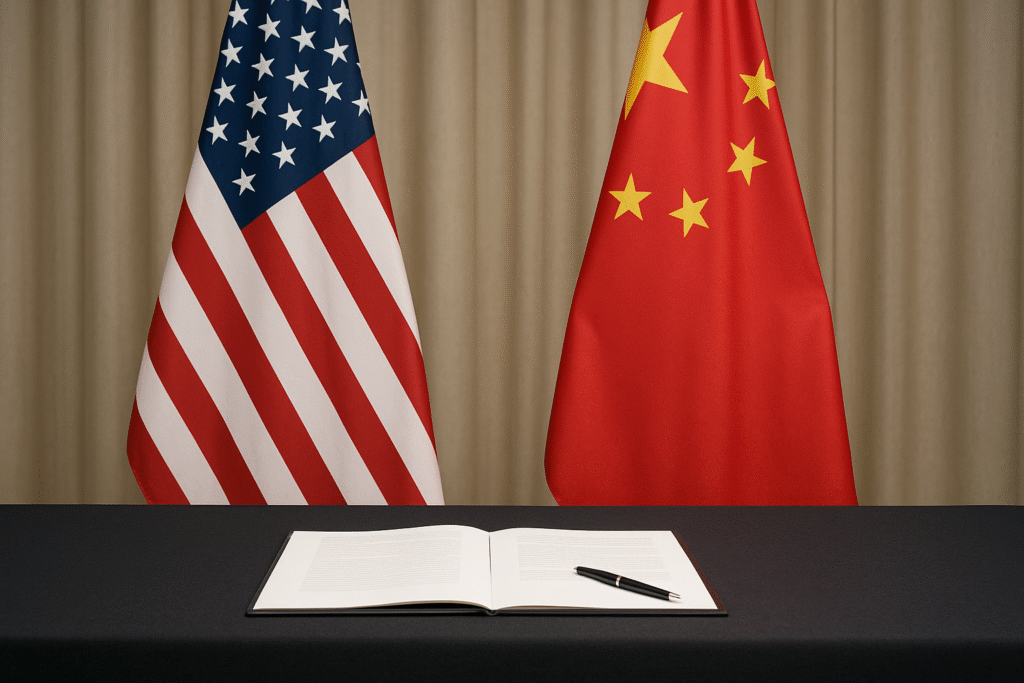
Top trade negotiators for the United States and China have reached a “preliminary consensus” on a new trade framework, signaling a significant de-escalation in the trade war that has rattled global markets for years. The breakthrough agreement, announced from Kuala Lumpur, Malaysia, on the sidelines of the high-profile ASEAN summit, offers a much-needed respite for businesses and investors worldwide, who have long grappled with the uncertainty stemming from the trade hostilities between the world’s two largest economies.
This consensus represents a crucial step back from the brink of further escalation, which threatened to impose even more crippling tariffs and deepen existing supply chain disruptions. The timing, amidst a global economic slowdown and persistent inflationary pressures, underscores the urgency felt by both sides to find common ground, at least temporarily.
Key Takeaways from the Consensus:
Tariffs Halted: The US has agreed to take the threatened 100% additional tariffs on Chinese goods “off the table.” These tariffs, which would have impacted a broad range of Chinese imports, from consumer electronics to industrial components, had been a major point of contention. Their suspension brings immediate relief to American importers and consumers, preventing a likely surge in prices and a further squeeze on corporate profit margins. For global supply chains, it means avoiding another wave of disruption, allowing businesses to plan with greater certainty.
China Defers Controls: In return, Beijing will defer its recently announced, sweeping export controls on rare-earth minerals, which are critical for electronics manufacturing, renewable energy technologies, and defense industries. China holds a near-monopoly on the mining and processing of these essential elements, and the threat of export controls had sent shockwaves through industries reliant on them, from automotive to aerospace. This deferment averts a potential crisis in global high-tech manufacturing and underscores the strategic importance of these materials in geopolitical leverage.
Agricultural Purchases: China has also reportedly agreed to make “substantial” purchases of US soybeans, a key point of negotiation and a long-standing demand from American farmers. The trade war had severely impacted the US agricultural sector, particularly soybean farmers who saw their largest export market significantly curtailed. This commitment offers a lifeline to a vital segment of the US economy and serves as a tangible goodwill gesture from Beijing, addressing a politically sensitive issue for the US administration.
Framework for Leaders: This agreement establishes a framework for a more comprehensive deal to be finalized by President Donald Trump and President Xi Jinping at their upcoming meeting. While the specifics of this broader deal are yet to be determined, it is expected to tackle deeper, more structural issues such as intellectual property protection, forced technology transfers, market access for US firms in China, and state subsidies for Chinese industries – issues that have been at the heart of the trade dispute.
The talks, led by US Treasury Secretary Scott Bessent and Chinese Vice Premier He Lifeng, concluded on Sunday after two days of intense negotiations. According to US officials, the framework also includes progress on resolving disputes over fentanyl trafficking and the status of TikTok.
Related Coverage: Read our detailed report on Mecom Gas Plans $20M IPO Amid Pakistan’s LPG Demand Surge.
Beyond Core Trade: Fentanyl and TikTok
The inclusion of fentanyl trafficking in the discussions highlights the US’s persistent concerns over the opioid crisis and China’s role as a major source of precursor chemicals. Progress on this front would represent a significant win for US public health efforts and demonstrate a broader commitment to cooperation beyond purely economic matters. Similarly, the mention of TikTok, the popular short-form video app owned by Chinese company ByteDance, points to ongoing US national security concerns regarding data privacy and potential influence, suggesting that technological and data governance issues remain intertwined with trade relations.
Global Market Reaction and Expert Perspective
The new consensus marks a significant cooling-off period in the trade war. Tensions had escalated earlier in the month when China announced its plan for rare-earth export controls, prompting the US threat of crippling tariffs. This truce is expected to bring stability to global markets, which have been volatile in response to the conflict between the world’s two largest economies. Stock markets globally, particularly in Asia, are anticipated to open positively, reflecting renewed investor confidence. “This preliminary deal removes a significant overhang of uncertainty,” noted Dr. Anya Sharma, a senior economist at Global Macro Advisors. “While it’s not a comprehensive resolution, it signals a willingness from both sides to prevent further escalation, which is a crucial first step for global economic recovery.”
Implications for Pakistan’s Economy
For Pakistan, an emerging market heavily reliant on global trade and investment, the de-escalation of the US-China trade war is unequivocally positive. A stable international trade environment directly benefits Pakistan’s export-oriented industries, particularly textiles, apparel, and leather goods, which often navigate complex global supply chains. Reduced uncertainty in major economies like the US and China means more predictable demand for Pakistani products and less risk of collateral damage from trade disputes. Global economic stability also tends to keep commodity prices, including oil, in check, which is a significant relief for Pakistan’s import bill and helps manage inflationary pressures.
Moreover, a less confrontational US-China relationship can indirectly foster a more conducive environment for foreign direct investment (FDI) into emerging markets. With global investors feeling more secure, capital flows might increase, potentially benefiting Pakistan’s efforts to attract much-needed investment for infrastructure and industrial development, including projects under the China-Pakistan Economic Corridor (CPEC). The stability could also ease pressure on the Pakistani Rupee by reducing global risk aversion. However, Pakistani policymakers must remain vigilant, leveraging this period of stability to implement structural reforms and enhance domestic competitiveness to fully capitalize on the improved global economic outlook.
Challenges and the Road Ahead
Despite the optimism, it is crucial to remember that this is a “preliminary consensus.” The path to a comprehensive, lasting trade deal remains fraught with challenges. Deep-seated structural issues, ideological differences, and technological rivalry between Washington and Beijing persist. The upcoming meeting between Presidents Trump and Xi will be critical in determining whether this framework can evolve into a more enduring resolution or if it merely provides a temporary pause in a protracted economic and geopolitical competition.
PS: For educational purposes only. Not financial advice. Investing involves risk.