
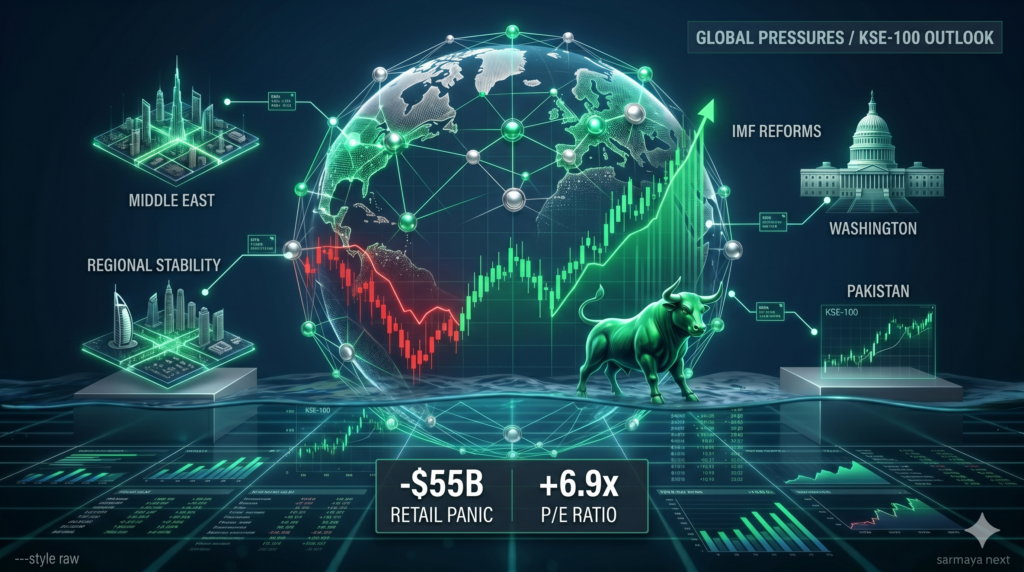
Most PSX investors watch earnings results, dividend announcements, and budget news. These are the visible forces. But experienced market participants know that the real drivers of the KSE-100’s largest single-day moves in 2026 have been the macroeconomic factors affecting PSX — including Middle East geopolitics, oil price volatility, foreign investment flows, and currency expectations. A ceasefire announcement, an oil price spike, or a leaked peace memorandum can move the market far more than a company’s quarterly results.
This article covers the three macro forces that the IMF visit specifically flagged — and that will determine the PSX’s trajectory in the second half of 2026 far more than any individual company’s quarterly results.
Force 1: The Middle East Conflict and Pakistan’s $800 Million Weekly Bill
Pakistan’s most immediate and most underestimated economic vulnerability is its dependence on Gulf oil. The country imports virtually all of its petroleum — petrol, diesel, furnace oil, jet fuel. With the Strait of Hormuz disrupted and Brent crude above $110 per barrel, Pakistan’s weekly energy import bill has surged to approximately $800 million. Annualized, this is a $41.6 billion drain on foreign exchange.
To put this in context: Pakistan’s total exports are approximately $35 billion per year. The country is spending more on oil imports than it earns from all its exports combined. This is the single most destabilizing force in the current economic picture — and it is the reason the State Bank of Pakistan (SBP) raised interest rates by 100 basis points in April despite a broadly improving domestic economy.
The IMF acknowledged this directly in its May 20 statement, noting that discussions covered “the impact of ongoing disruptions from the conflict in the Middle East” as a primary concern.
For PSX investors, the oil price functions as an inverse barometer:
When oil rises: Inflation rises, the rupee weakens, interest rates go up, and the PSX falls.
When oil falls: Inflation eases, the rupee stabilizes, rate cuts become possible, and the PSX rallies.
The most dramatic illustration of this mechanism was April 8, 2026: when news broke of a US-Iran ceasefire and oil dropped sharply, the PSX gained a record 14,251 points in a single session.
Force 2: FDI — The Missing Piece of Pakistan’s Recovery
Here is the uncomfortable truth that the IMF visit exposed: portfolio investment in the PSX has been positive — foreign investors net-buying Pakistani equities in several sessions since the programme began. But productive, job-creating Foreign Direct Investment (FDI) has actually declined.
FDI measures money that builds factories, installs machinery, creates employment, and generates export revenues over the long term. This type of investment has been the missing ingredient in Pakistan’s recovery story. The IMF flagged it as a structural concern that fiscal stability alone cannot solve.
The Special Investment Facilitation Council (SIFC), launched in 2023, was designed to fast-track Gulf state investment into Pakistan. Saudi Arabia, the UAE, and Qatar have all made commitments — in agriculture, real estate, energy, and logistics. But committed investment and deployed capital are two different things. The gap between announcement and execution has been Pakistan’s persistent challenge.
Two developments from the IMF visit are relevant here:
The RSF Framework: The climate-linked $1.3 billion arrangement explicitly requires Pakistan to integrate climate considerations into investment planning. This is significant because it opens an entirely new category of patient, long-horizon capital: green bonds, climate-linked sukuk, and ESG-oriented institutional investors who were previously excluded from Pakistan’s investment landscape by its B- credit rating but are now attracted by the RSF’s multilateral backing.
The World Bank Reclassification: Moving Pakistan from the South Asia to the MENA AP region changes which institutional fund managers are mandated to consider Pakistani assets. MENA-focused sovereign wealth funds, regional development banks, and Gulf-based family offices now include Pakistan in their investable universe by default. This structural reallocation of institutional attention is slow-moving but potentially transformative.
For PSX investors, the FDI story matters for specific sectors. Banks benefit as financial intermediaries for capital inflows. Infrastructure developers benefit from PSDP-linked and SIFC-linked project financing. Technology companies benefit from international clients and partnerships.
The most FDI-sensitive stocks on the PSX are companies that have historically attracted foreign strategic investors, as well as financial institutions with significant international shareholder ownership.
Force 3: The Exchange Rate — Liberalisation on IMF’s Agenda
The IMF’s managed float requirement — its insistence that the Pakistani rupee be allowed to move freely based on market forces rather than administrative controls — is one of the most consequential and least-discussed aspects of the programme for PSX investors.
Pakistan’s brief experiment with an administrative exchange rate ceiling in 2023 under then-finance minister Ishaq Dar demonstrated the dangers vividly. When the ceiling was removed, the rupee crashed from PKR 230 to PKR 285 in days — creating enormous economic disruption. Today’s rate of approximately PKR 278-280 is described by most analysts as broadly reflecting economic fundamentals, supported by strong remittances and a positive current account rather than artificial suppression.
But the IMF continues to push for greater flexibility. A formal free-float roadmap was reportedly discussed during the May visit and is expected to be formalized by Q1 2027.
For PSX investors, currency exposure determines winners and losers in a depreciation scenario with extraordinary clarity:
The Winners: Companies that earn in US dollars — IT exporters, offshore-oriented businesses, and companies with significant export revenues — benefit directly from any rupee weakness.
The Losers: Companies that rely heavily on imported raw materials priced in US dollars—particularly manufacturers importing machinery and chemicals, and automobile assemblers importing CKD kits and components—face immediate cost pressures when the rupee weakens.
This is not theoretical. In 2023, when the rupee fell 30%, IT companies’ PKR-reported revenues jumped without any change in its underlying business performance. Import businesses’ losses deepened without any change in its operating decisions. Currency exposure is arguably the single most important factor to understand before building a PSX portfolio.
What These Three Forces Mean Together
Understanding these hidden forces, alongside the major macroeconomic factors affecting PSX, is what separates reactive investors from prepared ones.
The Middle East oil situation, the FDI trajectory, and the exchange rate liberalisation agenda all point in the same direction: these primary macroeconomic factors affecting PSX mean that Pakistan’s 2026 investment story is fundamentally a macro story, not a stock-picking story.
The most important decision a PSX investor makes in 2026 is not which stock to buy. It is which scenario to position for:
In the peace scenario (oil falls, inflation eases, rates drop, PKR stabilizes, FDI improves, economy accelerates): Own banks, cement, FMCG, and automobiles.
In the conflict-continuation scenario (oil stays high, inflation persists, rates remain elevated, PKR weakens): Own IT exporters, dollar-linked businesses, and defensive income stocks with high dividend yields.
The beautiful reality of Pakistan’s current market: the best stocks in the peace scenario are also the safest stocks in the conflict scenario. Quality businesses with strong earnings, manageable debt, and consistent dividends perform adequately even in the difficult scenario and outperform dramatically in the favorable one.
That asymmetry — where quality stocks offer defensiveness in bad times and acceleration in good times — is the fundamental case for investing in Pakistan’s equity market right now.
For educational purposes only. Not financial advice. Investing involves risk.